


In Birmingham and across the West Midlands, the restoration of brickwork, timber beams, stone masonry, steel structures, and architectural features often begins with abrasive blasting. While the term “sandblasting” is frequently used in everyday speech, the world of blasting is far more nuanced. Choosing the right blasting technique is vital for achieving clean, damage-free results and preserving the character of historical or delicate materials.
In what follows, we explore three of the most widely used abrasive-blasting methods — sandblasting, shot blasting, and soda blasting — how they differ, when to use each, and which surfaces they are best suited for in the Birmingham environment.
What Is Abrasive Blasting?
Abrasive blasting refers to any process that propels solid particles (the “abrasive media”) at high velocity against a surface, in order to clean, strip, etch, or roughen it. The blasting medium might be sand, steel shot, baking soda, glass beads, or other materials. Choosing the correct media, pressure, nozzle geometry, and containment is essential to balance cleaning power with safety and substrate preservation.
In a city like Birmingham, where many buildings have masonry, timber framing, or historic steelwork, using the proper blasting method is critical to avoid over-aggressive removal or substrate damage.
Sandblasting
What It Is & How It Works
“Sandblasting” in the purest sense uses silica sand as the abrasive medium, but in practice it often refers loosely to any blasting method using mineral or angular abrasives. The media is mixed with compressed air (or in some cases water for wet blasting) and directed at the surface through a nozzle.
Because the particles are often angular and hard, sandblasting is an aggressive cleaning method. It cuts into the surface to remove coatings, rust, grime, or old render. However, modern blasting often substitutes safer or more appropriate media (such as garnet, alumina, or glass beads) for pure silica sand, particularly in environments where health or substrate sensitivity is a concern.
When to Use It
- Heavy paint or varnish removal: Layers of paint or varnish on timber, masonry or metal that require robust cutting action.
- Deep rust, scale or corrosion removal on steel or cast iron.
- Preparation for re-coating: when you need a clean, roughened “anchor” surface for new paint or coatings to adhere.
Suitable Surfaces
- Masonry and brickwork: Sandblasting can remove graffiti, soot, or layers of paint from bricks, revealing their original tone. Specialized micro-compressor setups are used to prevent over-blasting on stone or brick.
- Timber and wood beams: With care and low-pressure settings, sandblasting can lift varnish and paint from oak beams or historic timbers, retaining grain detail.
- Steel and ferrous metals: Ideal for cleaning steel beams, structural profiles or metal surfaces prior to painting or galvanizing.
In Birmingham, specialist teams often deploy low-pressure, precision sandblasting to restore oak beams, reveal natural timber grain, or strip paint from brickwork without damaging the substrate.
Shot Blasting (and Grit Blasting)
What It Is & How It Works
Shot blasting (sometimes paired with grit blasting) uses spherical or angular metallic media (commonly steel shot or grit) that is projected at tremendous velocity, often via a wheel or centrifugal system rather than just compressed air. The momentum and mass of the shot deliver more impact force, enabling more intensive cleaning or peening.
Shot blasting is generally more aggressive than sand-based blasting. The media can be recycled in many systems, making it efficient for large-scale or industrial applications.
When to Use It
- Heavy-duty coating or scale removal: tough, thick layers of paint, heavy corrosion, or scale on structural steel.
- Surface profiling: creating a uniform roughness depth to specifications (for example before applying industrial coatings).
- Peening or work-hardening: in certain engineering applications, shot blasting can introduce beneficial compressive stresses.
Suitable Surfaces
- Large steel components: girders, beams, plates, ship hulls, industrial plant components.
- Concrete or metal floors: preparation of worn concrete or steel floor slabs before overlay or coating.
- Fabricated steel work: structural sections, welded assemblies, pipeline segments.
Because shot blasting is powerful and can eject media with force, it often requires enclosure, strong PPE, and containment — especially for open-air jobs. In Birmingham’s restoration or industrial zones, steel frame structures or heavy plant components may be shot-blasted in controlled environments or mobile enclosures.
Soda Blasting (Baking Soda / Sodium Bicarbonate Blasting)
What It Is & How It Works
Soda blasting uses sodium bicarbonate (baking soda) particles propelled by compressed air. The media is much softer and more friable than mineral or metallic alternatives. On impact, the soda particles fragment (micro-explosion) and dislodge surface contaminants with relatively low mechanical abrasion.
Because soda is gentle, it’s often considered a non-destructive or delicate method — able to strip coatings, soot, or fire residues while leaving the underlying substrate intact.
When to Use It
- Delicate surfaces or soft materials: where harsh abrasives might cause etching or damage.
- Cleaning following fire and smoke damage: soda’s mild chemical reaction can help deodorize surfaces.
- Masonry or historic brickwork: stripping soot or paint from heritage stone or brick, removing grime while preserving texture.
- Timber restoration: lifting paint or varnish from oak frames or exposed beams without sanding away fine grain.
Suitable Surfaces
- Wood and timber beams: ideal for restoring oak beams, staircases, and frames, removing coatings while preserving surface detail.
- Brick and stone: cleaning soot-stained masonry or brick without eroding the stone face.
- Industrial equipment and machinery: where minimal abrasion is required — for instance, removing grease, oil, or light deposits.
- Fire-damaged surfaces: soda’s deodorising effect helps in remediation of smoke-affected walls or structural elements.
In Birmingham’s context, soda blasting is often used for interior restoration projects where preserving fine detail and minimizing dust or damage is paramount.
Choosing the Right Method: Considerations & Best Practices
Substrate Sensitivity
Not all surfaces are equal. Historic soft stone or aged timber cannot tolerate aggressive abrasives. Soda blasting or very low-pressure sand techniques may be safer. Steel elements, conversely, may require shot blasting to fully remove thick coatings.
Required Cleaning Intensity
How deep is the contamination? For superficial grime or soot, soda or micro-blast methods may suffice. For heavy coatings, rust, or multi-layer paint, you’ll need more aggressive media like steel shot or alumina grit.
Dust, Containment, and Safety
Aggressive blasting generates heavy dust and fragments. Proper containment, dust extraction, and operator protection are essential. Soda blasting produces far less abrasive dust but still demands care to prevent inhalation or spread of debris.
Final Surface Profile
When reapplying coatings, sometimes you want a roughened “anchor” finish (often achieved via shot or grit). On decorative or heritage surfaces, you may prefer a smooth or natural finish (favoring sand or soda).
On-Site Constraints
Access, location (indoor vs outdoor), proximity to walls or ornamentation, and logistics must be considered. Sometimes the only viable approach is a gentler or more controlled method.
In Practice: Birmingham Applications
- Brick façades and chimney stacks often benefit from precision low-pressure sand or soda blasting to remove old paint and expose the original red brick without weakening mortar joints.
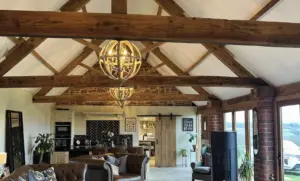
- Timber beams and historic oak frames inside period homes are commonly restored via gentle sand or soda blasting to strip varnish or paint while preserving original grain and patina.
- Steel structural elements or factory equipment may be shot-blasted to strip layers of corrosion and coatings prior to repainting or galvanizing.
- Fire-damaged interiors — soda blasting is particularly effective at removing soot and odor while being kind to plaster, woodwork, and brick.
A Powerful Tool
Abrasive blasting is a powerful tool for restoration, cleaning, and surface preparation — but only when matched correctly to the material and context. In Birmingham, where historic buildings, timbered interiors, brick façades, and steel structures coexist, choosing sandblasting (or mineral-media blasting), shot blasting, or soda blasting wisely can make the difference between a successful restoration and inadvertent damage.
Sand or mineral-based blasting is the all-around workhorse; shot blasting brings industrial-level force; soda blasting offers a gentle, substrate-friendly alternative. The ideal blasting contractor in Birmingham will assess the material, coating, location, and risk profile before recommending the optimal method. When done with skill, care, and the right equipment, abrasive blasting breathes new life into surfaces — revealing hidden beauty and preparing them for their next chapter.